Lid-Driven Cavity Flow Simulation
Vorticity–stream function CFD solver development
Jan 2025 - May 2025 | IIT Roorkee, India
Project Context
This project involved numerical simulation of 2D incompressible flow in a square lid-driven cavity using the vorticity–stream function formulation. The problem served as a benchmark CFD case to validate numerical implementation, boundary conditions, and solver behavior.
Engineering Problem
Obtain a physically correct solution for lid-driven cavity flow
Correct improper enforcement of top-wall velocity boundary conditions
Ensure stable convergence of the coupled vorticity–stream function equations
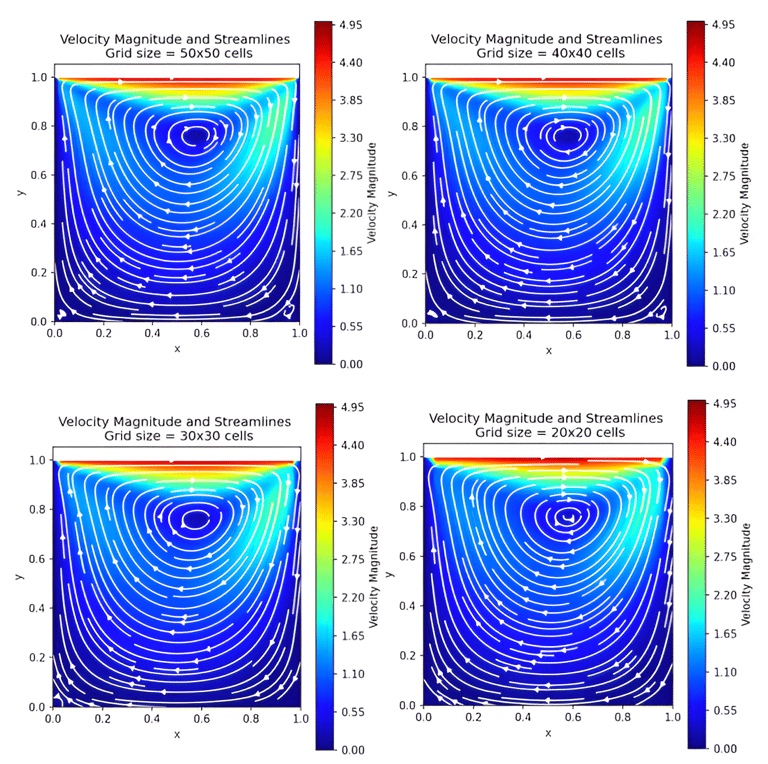
Study the impact of flow velocity and mesh resolution on accuracy and runtime
Approach & Methodology
The governing vorticity transport and Poisson stream-function equations were discretized using finite differences and implemented in Python. A Successive Over-Relaxation (SOR) scheme was used to solve the stream-function equation at each time step. Boundary conditions for vorticity and stream function were analytically derived and explicitly enforced at all walls, with special treatment of the moving lid. Velocity components were computed from the stream function using central differencing. Parametric studies were performed by varying top-wall velocity and mesh resolution, with convergence and CFL stability monitored.
Key Results
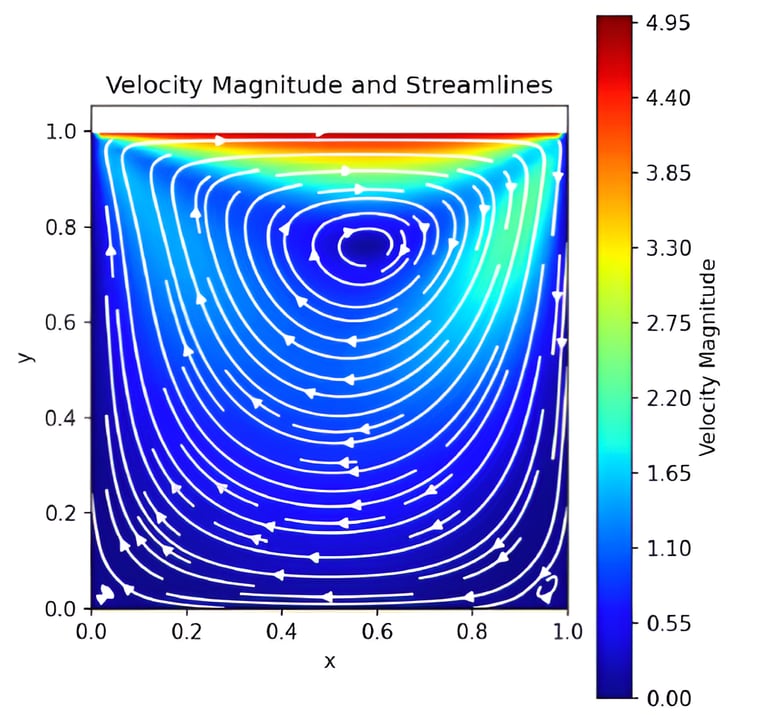
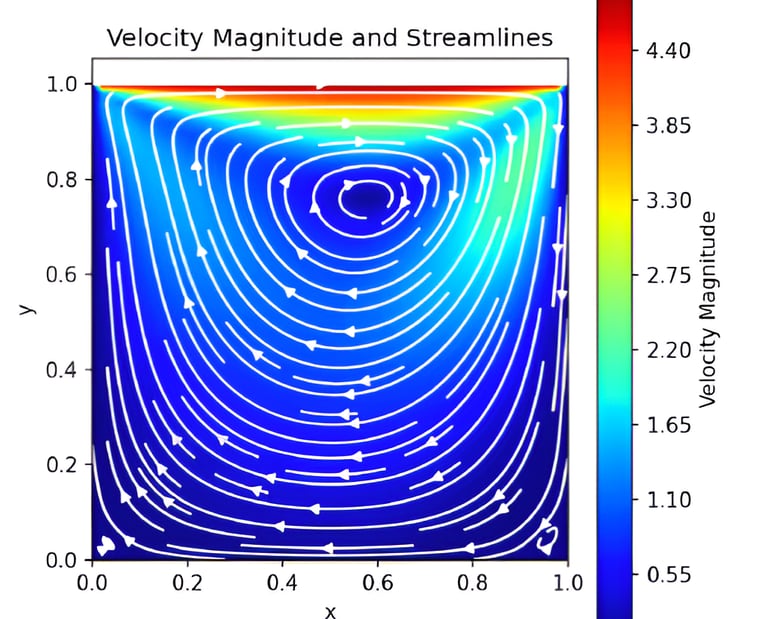
Correct enforcement of boundary conditions restored the prescribed top-wall velocity and eliminated unphysical zero-velocity behavior
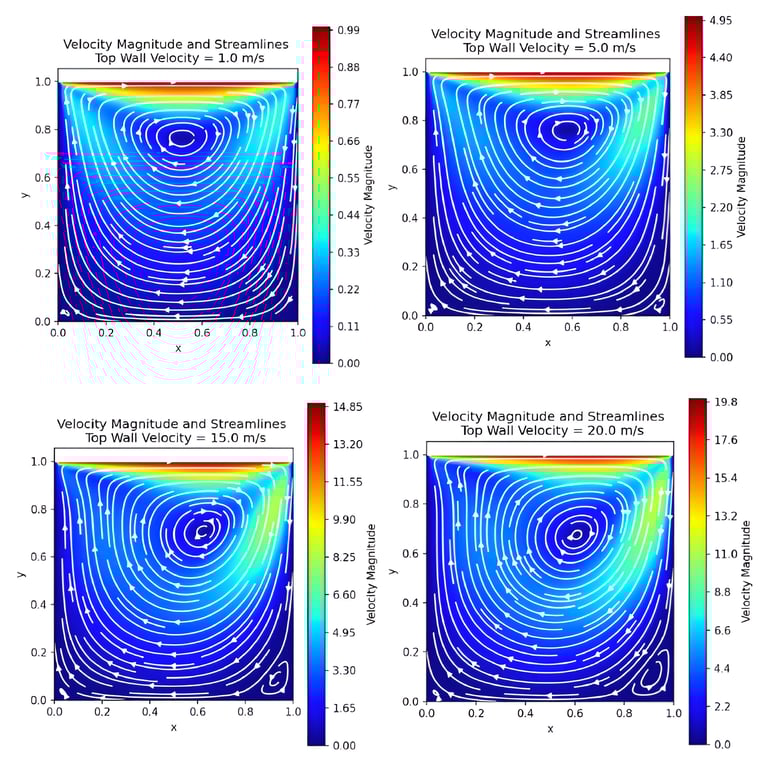
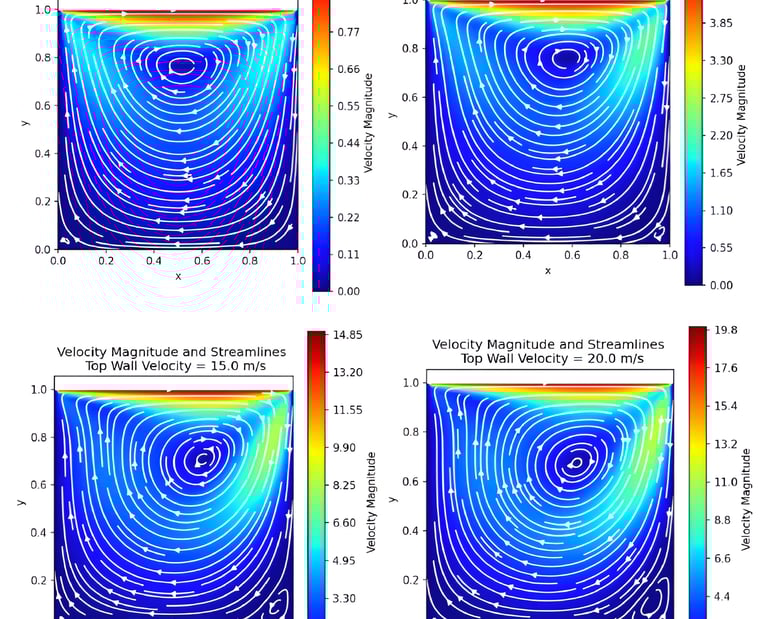
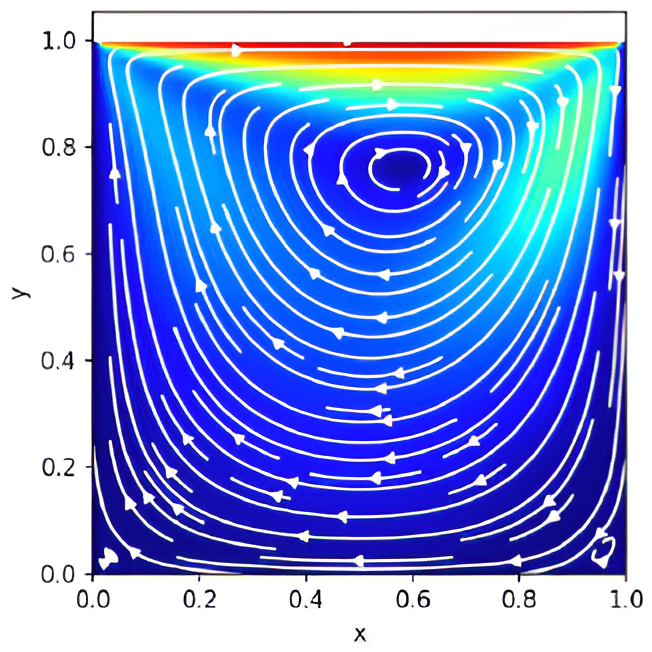
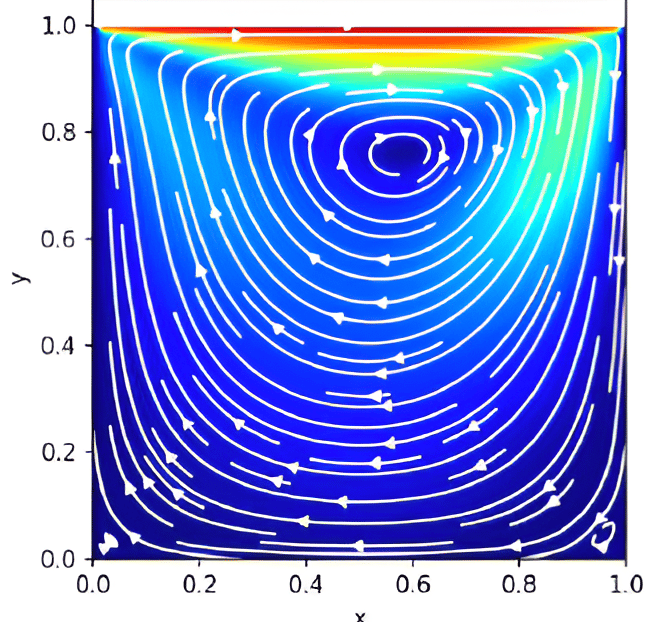
Formation of a primary central vortex with secondary corner recirculation zones observed at steady state
Increasing lid velocity (1–20 m/s) intensified circulation and shifted the primary vortex toward the downstream side
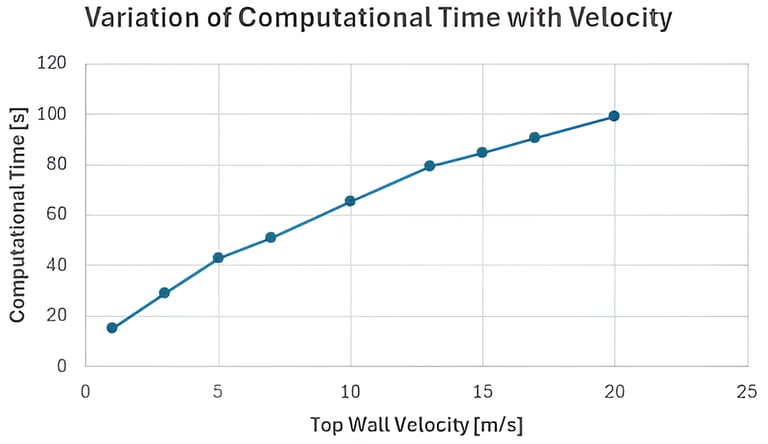
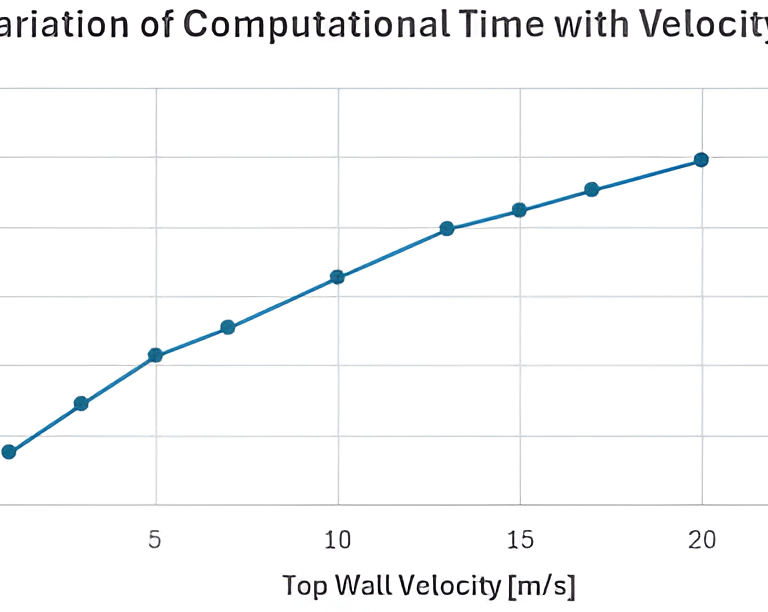
Computational time increased approximately linearly with lid velocity due to slower SOR convergence
Simulations became unstable beyond ~20 m/s due to CFL condition violation
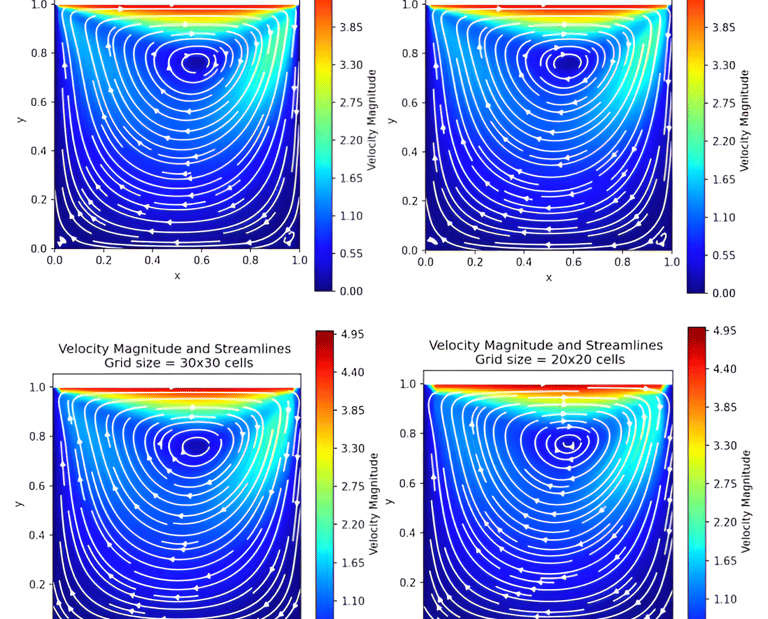
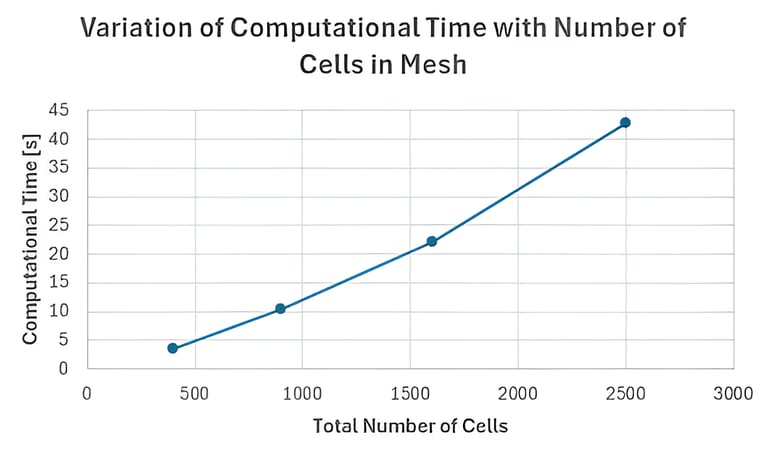
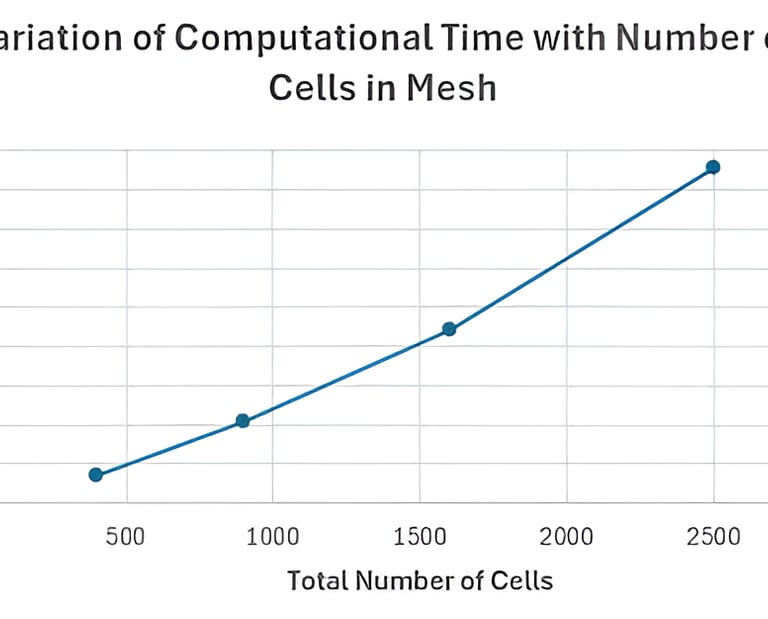
Mesh refinement improved resolution of secondary vortices but caused a sharp increase in computational time
Engineering Judgment & Trade-offs
Explicit boundary treatment improved physical accuracy but required careful handling of wall vorticity expressions. Higher lid velocities and finer meshes improved flow resolution at the cost of numerical stability and runtime. The study highlighted the trade-off between computational efficiency and fidelity in explicit time-marching CFD solvers.
Tools & Methods
Python, NumPy, Matplotlib, finite-difference discretization, vorticity–stream function formulation, SOR iterative solver.
Outcome / Takeaway
The project delivered a corrected and validated CFD implementation for a classical benchmark flow. It demonstrated strong understanding of boundary-condition enforcement, numerical stability limits, and resolution–cost trade-offs in incompressible CFD.